
How BlueLume Glasses work in short
BlueLume Glasses bring three functions into one lens: near-to-far vision, transition lenses and a blue light and UV filter. Everything works on its own, without a battery or settings. You put them on and use them for everything you used to need several pairs for.
Near and far with one pair
From around your mid-40s, the lens in your eye gradually loses its ability to focus up close. It's completely normal and happens to almost everyone. The typical sign: you hold your phone further and further away, and for the small print you need readers, which you then take off to look across the room.
According to the brand, BlueLume lenses are designed to cover the changing distances of everyday life: menu, phone, screen and the street beyond. No more taking your glasses on and off.
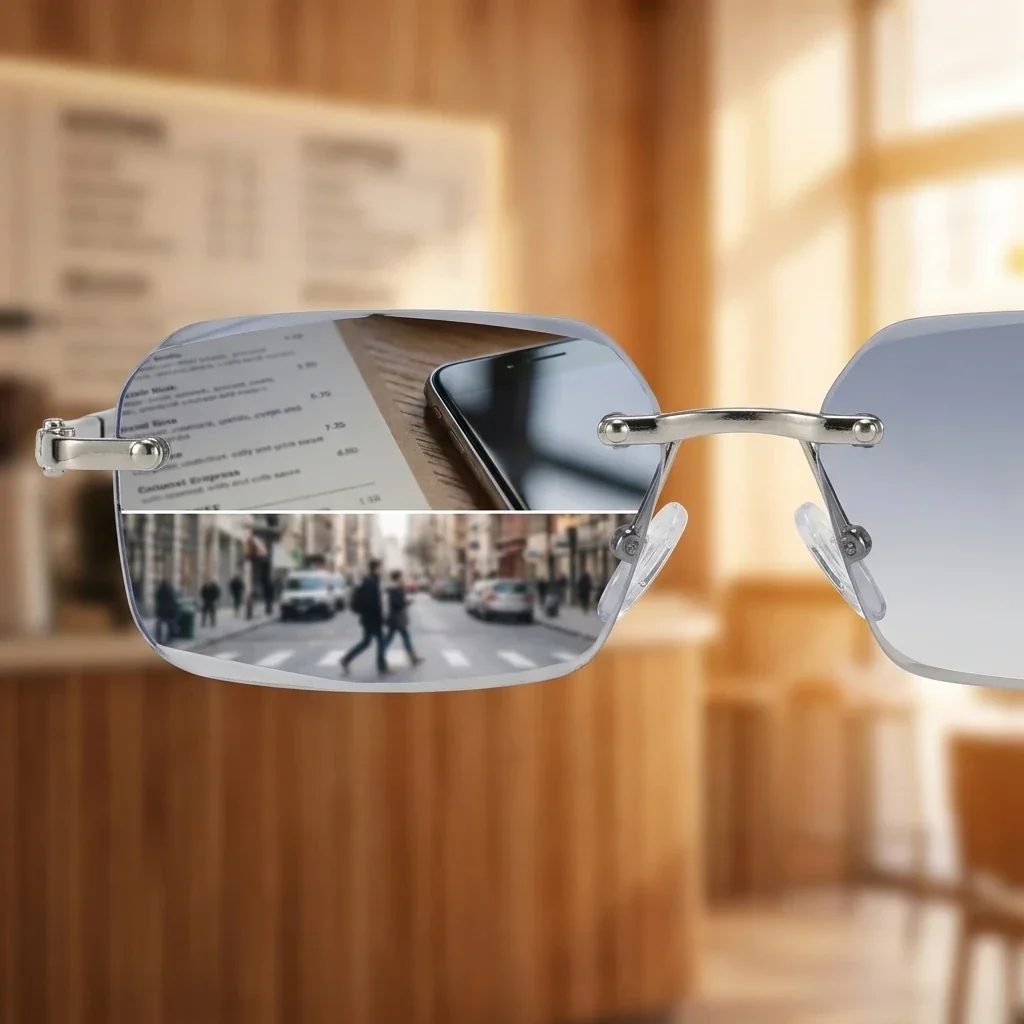
Transition lenses: dark outdoors, clear indoors
BlueLume lenses are photochromic. These lenses react to the sun's UV light: outdoors they darken automatically and reduce glare, indoors they turn clear again. That gives you everyday glasses and sunglasses in one, with nothing to do when you move between indoors and outdoors.
Good to know: behind a car windshield, photochromic lenses usually darken less, because windshields block most UV light.
Blue light filter for screen days
Phones, laptops, tablets and TVs emit a high share of blue light. The built-in blue light filter in BlueLume Glasses reduces that share, which many people find more comfortable during long screen sessions. And because the lenses cover near and far, you can look up from your monitor and across the room without taking your glasses off.

Are BlueLume Glasses right for me?
BlueLume Glasses are non-prescription glasses. They're especially suitable if you currently use simple readers and need little or no correction for distance. They don't replace custom-fitted prescription glasses.
- You use readers and sunglasses and switch all the time.
- You spend a lot of time at screens.
- You want one light pair for indoors and outdoors.
Talk to your optometrist or ophthalmologist first if you
- have an eye condition such as cataracts, glaucoma or macular degeneration,
- have strong astigmatism or very different prescriptions in each eye,
- notice sudden changes in vision, double vision or eye pain.
Everyday tips
- Give it a few days: if you've never worn near-to-far glasses, you'll usually get used to them quickly, but not always instantly.
- Adjust the nose pads: if they sit too high or too low, gently bend the pads.
- Clean them properly: use a microfiber cloth and a little water, not paper tissues.
- Keep spares: with the 3-pack, there's always a pair in the car, at your desk and in your bag.
Our verdict on how they work
BlueLume Glasses combine three pairs in one: near-to-far lenses that darken outdoors on their own and filter blue light at the screen. That makes everyday life noticeably simpler. If you don't need an individual prescription, you get a light, versatile pair you can try at your own pace with a 90-day money-back guarantee.
BlueLume at the official storeFrequently asked questions
How do BlueLume Glasses work?
According to the brand, the lenses cover distances from near to far, darken automatically in sunlight and filter blue light and UV. No power or settings are needed.
Do the lenses darken in the car?
Photochromic lenses react to UV light. Because windshields block most UV light, these lenses usually darken less behind the windshield than outdoors.
How long do the lenses take to darken?
Photochromic lenses start darkening right away in bright light. Clearing up indoors usually takes a little longer than darkening outdoors.
Can I wear them for driving?
Many customers use them to read road signs. For driving, though, you must always meet the legal vision requirements. If you need corrective lenses to drive, ask your optometrist whether non-prescription glasses are enough.